---
title: "Dutch mortgage valuation reports: quality checks before submission"
description: "Check a Dutch mortgage valuation report for its purpose, independence, validation, dates, value and supporting evidence before sending it to the lender."
url: "https://taxateurrotterdam.com/en/guides/valuation-report-for-a-dutch-mortgage/"
locale: "en"
author: "Huib Faber"
publishedDate: "2026-08-28T00:00:00.000Z"
updatedDate: "2026-09-17T00:00:00.000Z"
categories: "Valuation report"
tags: "mortgage, NHG, validation"
---
# Dutch mortgage valuation reports: quality checks before submission
Check a Dutch mortgage valuation report for its purpose, independence, validation, dates, value and supporting evidence before sending it to the lender.
## TL;DR
Are you sending a valuation report to a lender? Read it as a dated file for a named recipient. Check the purpose, property, appraiser independence, NWWI review, value date, report age and evidence. The report supports the mortgage file; the lender makes the lending decision.
In 2026 the standard NHG limit is €470,000. NHG lists €498,200 when additional borrowing concerns energy-saving measures under its conditions. Income, debts, lender policy and the signed purchase agreement remain separate parts of the mortgage assessment.
## Why the report quality matters
When a lender requests NHG, compare the recipient’s conditions with [NHG valuation in Amsterdam](https://taxateuramsterdam.com/en/guides/nhg-valuation-in-amsterdam/) before you set the valuation date.
A lender needs a report it can identify, read and place in the correct file. A mismatch in address, purpose or recipient can create a question even when the value looks plausible. A missing date can make the age check impossible. A planned improvement needs a clear description when the lender is assessing the home after the work.
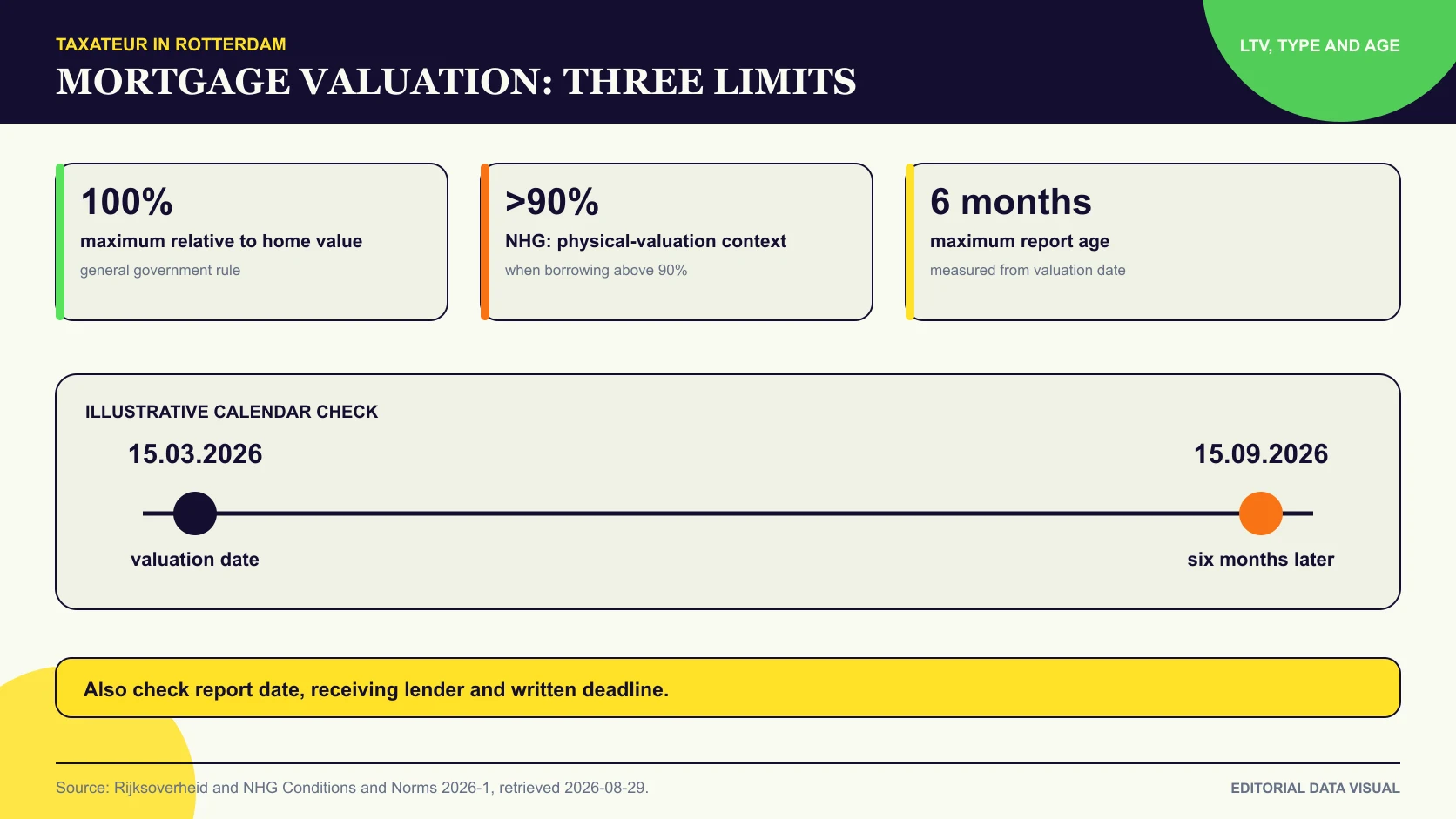
Rijksoverheid's maximum mortgage rule allows a mortgage up to 100% of the home’s value, subject to income rules and other obligations. This is a ceiling in a general rule, not an approval for your application.
If you are financing an apartment, compare split-deed, VvE and building-condition questions with [apartment appraiser selection criteria](/en/guides/best-property-appraiser-in-rotterdam-for-apartments/) before you request a report.
## The four-part quality test
Use four questions before sending the report:
1. **Purpose:** Does the report say whether the task concerns purchase, refinancing, improvement or another purpose?
2. **Recipient:** Is the named lender, adviser or other recipient correct?
3. **Date:** Can you see the inspection date, value date, report date and any delivery deadline?
4. **Evidence:** Does the report explain the property facts, comparable sales, assumptions and limitations?
Write the answer beside the relevant page or section. A question tied to a line is easier to resolve than a general feeling that the report seems thin.
## Check independence, NWWI review and the report date
NHG’s physical-valuation requirements say the maker must be independent, a recognised NWWI review institute must validate the report and the report may be at most six months old from the valuation date. Those points apply in the NHG context. Ask the lender what applies to the file when the mortgage does not use NHG.
NRVT describes objectivity and independence as professional principles. A register entry can answer a credentials question. It cannot tell you whether the proposed report has the right recipient, the right date or enough evidence for your lender.
NWWI describes NWWI review as a check on the appraiser and report against set quality requirements. The appraiser remains responsible for the value opinion and its explanation. NWWI review does not turn the report into a guarantee of lending.
## Ask what the report covers
Look for these property facts:
- address, property type and tenure;
- floor area, plot, rooms and access;
- maintenance, defects and completed improvements;
- energy information and relevant building parts;
- ground lease, VvE or other legal conditions;
- comparable homes, selection reasons and adjustments.
Read the comparable evidence as an argument. A nearby sale can still be a poor comparison when its date, condition, tenure or layout differs. A report’s conclusion gains meaning when the adjustments are visible.
## Read the evidence before submission
Place the purchase agreement, report and lender request beside one another. Check the address character by character. Compare the agreed price with the value and read the explanation for any difference. Mark every assumption about work that has not been completed. Confirm that attachments named in the report are present.
If the report discusses after-improvement value, NHG’s 2026-1 conditions expect the report to show the market value at the valuation moment, the changes needed and the market value after those changes. That three-part record helps a lender separate today’s security from a planned result.
## Red flags in a mortgage valuation file
A red flag is a missing explanation that can change the decision:
- the recipient is a different lender from the one named in the application;
- the value date is hidden or older than the lender allows;
- a planned extension appears in the value without drawings or a stated assumption;
- comparable sales are listed without dates, locations or adjustment logic;
- NWWI review is described as approval of the mortgage;
- a correction request has no owner or delivery date.
Ask a written question before forwarding the file. A lower value needs an explanation and a finance conversation. It does not by itself prove that the appraiser made an error.
## When a report needs a question, not a verdict
Apartment files add split-deed, VvE and building-condition questions to the recipient and NWWI review checks.
An informed critic could say that a checklist creates paperwork without improving the value. That can happen when boxes are recorded and the evidence is skipped. The checklist works when every answer points to a report location, a missing document or a person who must respond.
Uncertainty remains in every value opinion. Market movement after the value date, an undiscovered defect or a lender’s own policy can change the next step. Keep the report’s conclusion, the lender’s decision and your contract obligations as three separate notes.
## Frequently asked questions
### Can a valuation report guarantee my mortgage?
No. The report supplies property evidence and a value for its assignment. The lender also tests income, debts, documents, product conditions and its own acceptance rules.
### What is the 2026 NHG limit?
NHG lists €470,000 as the standard limit in 2026 and €498,200 when the additional borrowing concerns energy-saving measures under the stated conditions. Check the current NHG rules and the lender’s file instructions.
### How old can an NHG physical report be?
NHG says a physical valuation report may be at most six months old from the valuation date. The lender may set a tighter operational deadline for receiving or reviewing it.
### Does NWWI set the value?
The appraiser forms and explains the value opinion. NWWI checks the report against its NWWI review requirements. The two roles should stay separate in your notes.
## Send the question with the file context