---
title: "Property valuation when buying a home: fit the report to the deal"
description: "Plan a property valuation around your offer, the report purpose, valuation date, lender conditions, mortgage limits and completion deadline."
url: "https://taxateurrotterdam.com/en/guides/valuation-when-buying-a-home/"
locale: "en"
author: "Huib Faber"
publishedDate: "2026-08-28T00:00:00.000Z"
updatedDate: "2026-09-17T00:00:00.000Z"
categories: "For buyers"
tags: "buying a home, mortgage, valuation"
---
# Property valuation when buying a home: fit the report to the deal
Plan a property valuation around your offer, the report purpose, valuation date, lender conditions, mortgage limits and completion deadline.
## TL;DR
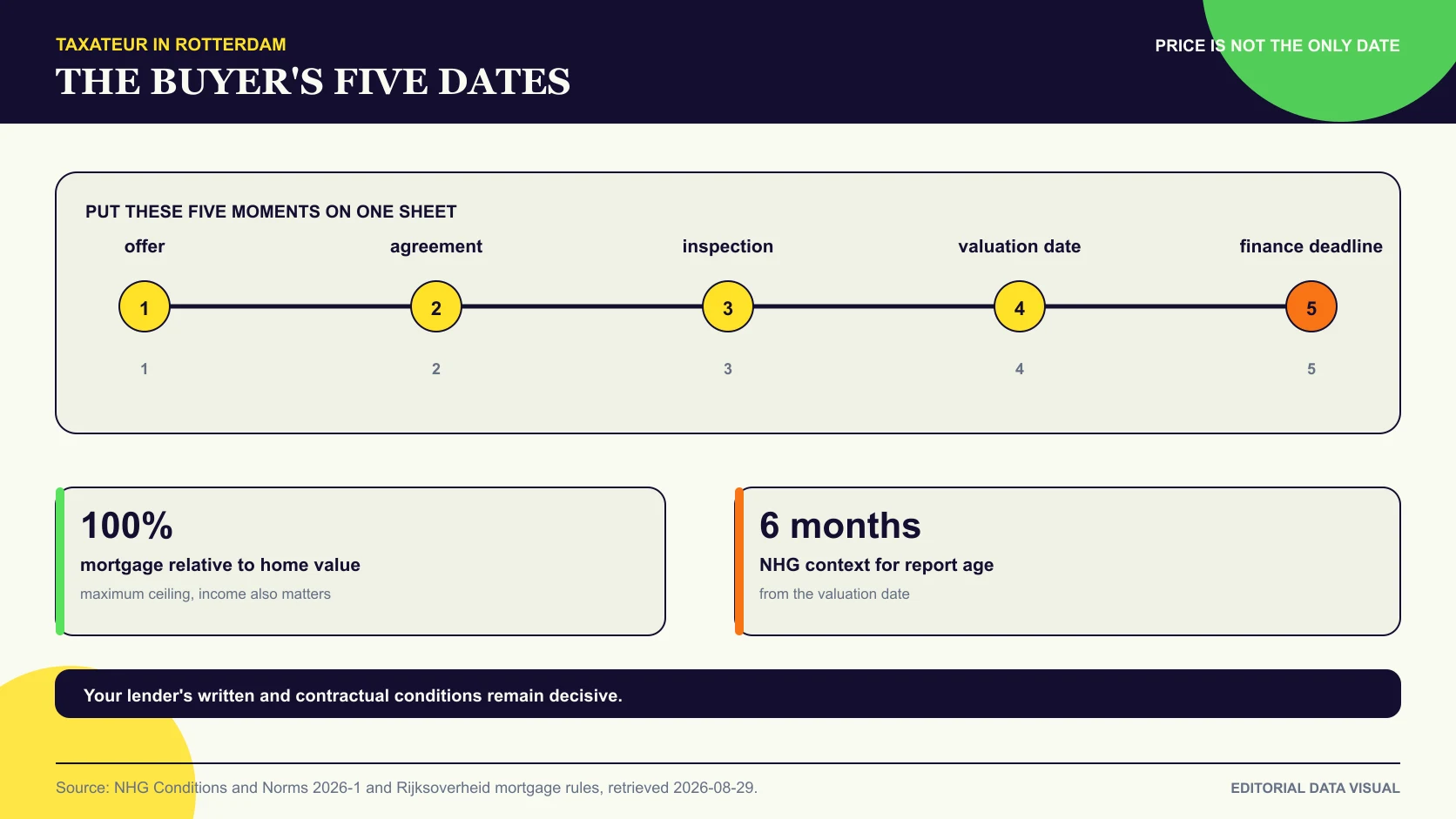
Are you buying a home in the Netherlands? Arrange the valuation once the offer, purpose, recipient and deadline are clear. Keep the offer or agreement date, inspection date, valuation date and mortgage or completion deadline visible.
Keep four dates visible:
- offer or agreement date;
- inspection date;
- valuation date;
- mortgage hand-in or completion deadline.
Before you send a purchase brief, compare the sequence of inspection, evidence and report handover with [how a property valuation in Amsterdam works](https://taxateuramsterdam.com/en/guides/how-does-a-property-valuation-in-amsterdam-work/) so the deadline matches the work.
Before you compare a purchase report with your borrowing plan, put the maximum mortgage rule beside the income and debt conditions.
If the property is new-construction, include [new-construction valuation checks](/en/guides/best-property-appraiser-in-rotterdam-for-new-build-projects/) in the same brief as the project stage, drawings, handover evidence and recipient requirements.
For a first purchase, compare lender wording, valuation date and dossier evidence with [first-time-buyer appraiser criteria](/en/guides/best-property-appraiser-in-rotterdam-for-first-time-buyers/) before you request a report.
A fictional calendar example can clarify the order. If the value date were 15 March, six months would reach 15 September. That is an illustration of elapsed time, not a promise that a lender accepts delivery on that date.
## From offer to report
**After the offer.** Ask the lender or adviser which valuation report it accepts. Confirm the intended recipient, required NWWI review and deadline before you book an appointment.
**Before the inspection.** Send the purchase agreement, property details, floor plans, ground-lease or VvE information, energy documents and any known alteration or permit fact. Mark what is missing.
**At the report stage.** Check the address, purpose, value date, comparable sales, assumptions and intended use. Keep a lower-than-expected value question tied to the evidence, not to a preferred result.
**Before hand-in.** Compare the report with the lender instruction. Ask who corrects a mismatch and whether an amended report needs another NWWI review step.
## Prepare the file
Create one folder with:
- signed or purchase agreement;
- lender or adviser instruction;
- property brochure and floor plans;
- measurements, photos and alteration notes;
- ground lease and VvE documents where relevant;
- permit or planning information;
- energy label and known defects;
- contact details for the recipient and deadline.
The file should distinguish fact, document and assumption. A planned extension is an assumption until the report and legal position say otherwise. A brochure can describe a feature; it does not replace the report’s inspection or evidence.
## Connect value to borrowing
Rijksoverheid says a mortgage can generally be no more than 100% of the home’s value. Income, debts and the lender’s product rules also affect the application. The valuation answers the property-value part; the lender assesses the full file.
NHG sets the 2026 standard limit at **€470,000**. NHG states **€498,200** where the extra borrowing is tied to energy-saving measures under its conditions. The limit is a product condition, not an amount you automatically qualify to borrow.
For an NHG physical valuation, NHG says the report must be made independently, validated by an accepted institute and be no more than six months old from the valuation date. Read this alongside the lender’s own delivery instruction.
## Where the sequence stalls
A purchase file often slows when:
- the report names the wrong lender or recipient;
- the value date is unclear;
- a planned alteration is treated as complete;
- comparable sales have no explanation;
- VvE or ground-lease information arrives late;
- the report’s age condition is checked only after the deadline;
- the buyer expects the valuation to decide income-based borrowing.
Each issue has a different owner. Put the question beside the document or person who needs to answer it.
A low valuation does not automatically mean the report is wrong. Ask the appraiser to explain the property facts, comparable selection and adjustments. Ask the lender or adviser what it means for the financing. Keep the purchase contract decision separate from the evidence review.
## Frequently asked questions
### When should I order the valuation?
Ask the lender which report it accepts and book early enough for inspection, report preparation, NWWI review and any correction. The exact timing depends on the file.
### Does a valuation guarantee the mortgage?
No. The lender also assesses income, debts, savings, product rules and the purchase documents.
### What if the valuation is below the offer?
Read the report’s assumptions and comparable evidence. Then ask the lender or adviser how the difference affects the financing and ask the appraiser about any factual error.
### Can I use an older report?
Ask the recipient. In an NHG physical-report context, NHG describes a six-month maximum from the valuation date.
## Ask before the deadline
For a new-construction or first purchase, keep the project stage, lender wording, valuation date and dossier evidence in the same brief.