10 questions about residential property valuations in the Netherlands
Get clear answers about Dutch home valuations, including the purpose, value date, evidence, mortgage reports and when your existing report may no longer fit.

Do you need to know which kind of home valuation fits your situation? Start with the purpose, property, value date and report recipient. A WOZ value, a market valuation and a mortgage report can concern the same address while serving different decisions.
For a Dutch purchase, match the lender’s question and intended recipient to a valuation report for the home purchase before relying on it.
For a Dutch purchase, match the lender’s question and intended recipient to the report’s scope before relying on it.
For a Dutch purchase, match the lender’s question and intended recipient to the report’s scope before relying on it.
For a Dutch purchase, match the lender’s question and intended recipient to the report’s scope before relying on it.
For a Dutch purchase, match the lender’s question and intended recipient to the report’s scope before relying on it.
A purchase question also depends on valuation timing in a home purchase when an accepted offer and a lender deadline create separate dates.
If your lender asks for an NHG file, compare the NHG physical valuation report requirements with the recipient’s brief before you set the valuation date.
These ten answers help you ask for the right information and spot when an existing report no longer fits your question. The figures belong to their own source and period; they do not give a value for your home.
TL;DR
Start with four fields: purpose, value date, evidence and recipient. Then ask whether the report is recent enough for that recipient and whether the file contains the property facts that support the conclusion.
The Dutch government describes a general borrowing boundary of up to 100% of the home value, while income, debts, interest and other obligations still affect a mortgage decision. A valuation can inform the property-value part of that decision; it does not decide affordability.
Questions that change the answer
Rijksoverheid and the Waarderingskamer set out the WOZ timing distinction. NHG sets dated conditions for mortgage reports, while NRVT material covers independence and investigation. National CBS figures add context for movement over time, not a value for one property.
A valuation has meaning only in relation to its purpose, property and date, which is why the purpose of a property valuation belongs in the opening brief. For a lender file, keep recipient, date, NWWI review and comparable evidence together.
Keep five checks beside the decision: purpose, value date, evidence, recipient and report age. The numbers organise your questions; they do not score a named valuer or replace the terms of the assignment.
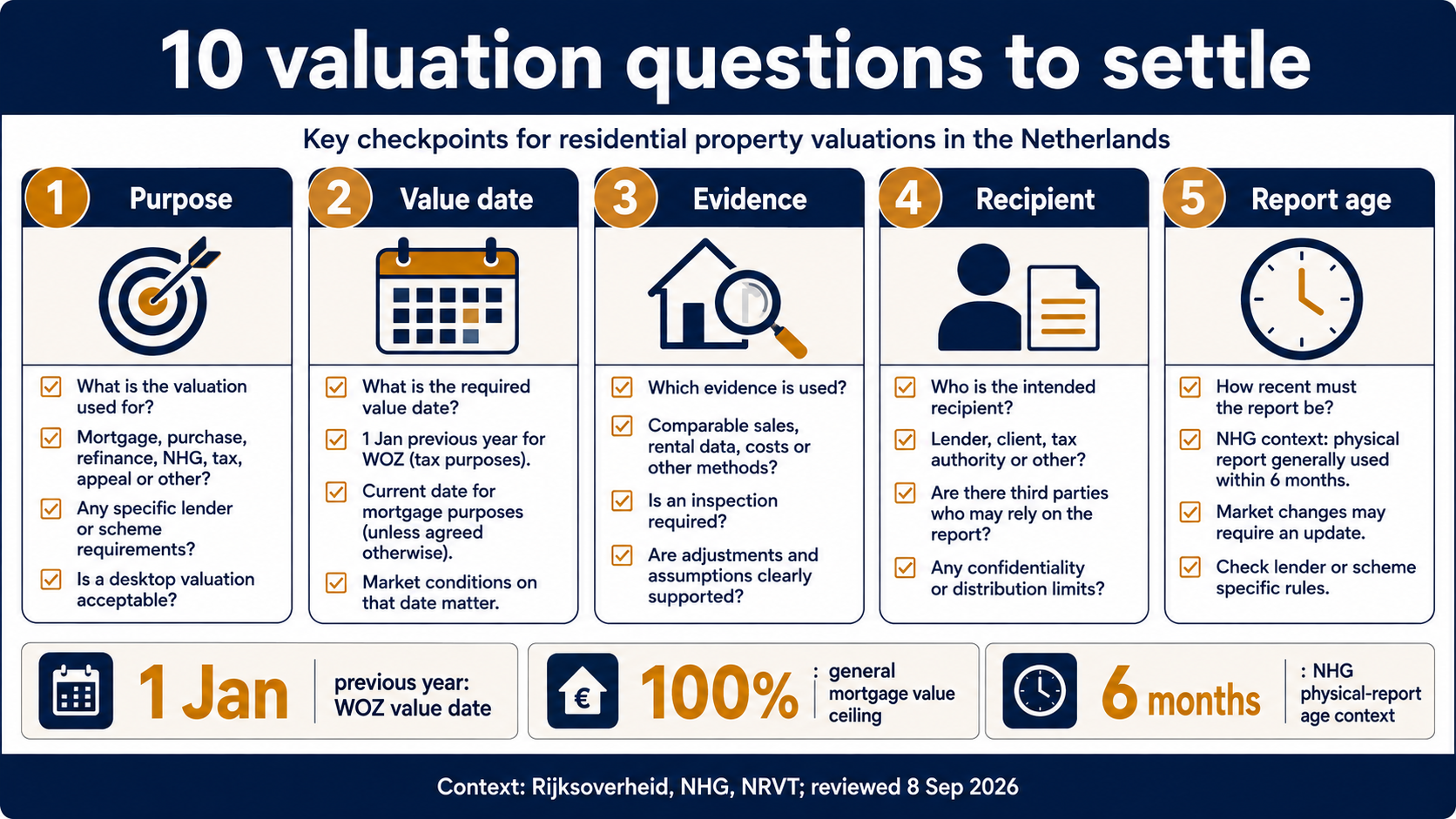
10 questions to settle
1. What does a residential valuation actually answer?
A valuer forms an opinion about value for a stated purpose and date after considering the property and relevant evidence. The conclusion is meaningful because the file explains what was considered and what limits apply. A quick online indication can help with orientation, while a formal report answers a different need.
2. Is a WOZ value the same as market value?
No two labels should be treated as one number. The WOZ value is set for municipal taxation and uses a value date that is one year before the tax year. A sale, refinance or mortgage question may require a current market-value opinion. The distinction between WOZ and market value keeps a municipal value apart from a current market question.
3. Which date belongs in the question?
Name the valuation date, the date of the property condition and the date by which the recipient needs the report. The Waarderingskamer distinguishes the value date from the state date, while market conditions keep moving between those moments. A report can be factually sound and still be a poor fit for a later decision.
4. How much can a valuation affect a mortgage?
The Dutch government states that borrowing for a home is generally limited to 100% of its value. Income, existing debts, the interest rate and other obligations still influence the amount a lender will accept. If the valuation comes in below the agreed price, the gap can become a funding question for the buyer.
5. What is special about an NHG file?
The NHG 2026 conditions set a standard purchase-price or cost limit of €470,000 and a higher €498,200 limit when the energy-saving conditions are met. Those limits are separate from the report rules. In the physical-report context, NHG requires an independent valuer, accepted NWWI review and a report no older than six months from the valuation date. For a Dutch purchase, match the lender’s question and intended recipient to the report’s scope before relying on it.
6. Which property details belong in the file?
Give the valuer the address, property type, rights, floor area, condition, alterations, leasehold or ground-right details and relevant association records. The exact list depends on the property. Missing facts can change the questions that the valuer can answer and can make a comparison with other homes less reliable.
7. How are comparable properties used?
Comparable sales are evidence, not a price menu. The valuer needs to explain why the homes are comparable and how differences in location, size, condition, rights, timing and quality affect the conclusion. NRVT disciplinary material stresses the value of own investigation and complete reference data. Distance alone is a weak selection rule.
8. When does independence matter?
Independence matters whenever another party relies on the conclusion. NRVT describes objectivity and independence as foundations of the valuer’s work. A requested outcome or a copied earlier report can weaken the reasoning. NWWI review may also matter when the named recipient requires an accepted NWWI review path.
9. When is an existing report too old for the question?
There is no single age rule for every purpose. A new lender, a changed property, a new contract date or a large movement in relevant evidence can justify a fresh question. The six-month condition in the NHG physical-report context is a useful example of a recipient rule, not a universal expiry rule.
10. Can a valuation answer a personal tax or mortgage decision?
It can supply one piece of evidence. Tax treatment, borrowing capacity, affordability and contract choices belong with the relevant qualified professional. The report should state its purpose and limits so one value opinion is not mistaken for a wider recommendation.
Comparison cards: which answer do you need?
Orientation. You want a first sense of value before deciding whether to sell, buy or ask for more work. A dated indication can frame questions, with no promise that a lender or buyer will accept it.
Formal market-value assignment. You need a valuer to inspect the property, weigh relevant evidence and explain the conclusion for a stated date and purpose.
Mortgage or NHG file. You need the named recipient, report type, NWWI review path, report age and document list confirmed before the appointment. The lender still assesses income and debts separately.
Municipal WOZ question. You are dealing with a tax value and its municipal procedure. A market-value report may help you ask better questions, while the objection or tax process has its own rules.
How to choose the next question
Write one sentence that includes the purpose, recipient, desired date and property change. Then add the evidence you already have and the point that remains unclear. When the question is whether a fresh opinion is worth commissioning, reasons to have a home valued regularly supply a separate decision frame. A purchase question also depends on the accepted offer and lender deadline, which can create separate dates.
Common questions about the decision
Does a higher asking price prove a higher value?
No. An asking price expresses a seller’s position. The valuation conclusion depends on the property, date, evidence and purpose.
Does the 2026 CBS price index give my home’s value?
No. CBS reports that the national existing-home price index was 153.6 in 2026 Q1 on a 2020=100 basis, with a 5.2% year-on-year increase. That is national movement context, not a Rotterdam address-level conclusion.
Can I send every document through a public form?
Send a focused question first. Keep passports, contracts, bank details and other personal documents out of the public form unless a qualified recipient gives you a secure channel.
When the question changes
An orientation value, a formal assignment and a mortgage report answer different questions. A new purchase date, recipient or purpose can make an existing report unsuitable even when the property has not changed.
What these checks can tell you
The figures here come from dated official material and national CBS context. They do not rank valuation firms, set a fee or decide a personal mortgage or tax outcome. Conditions can change, so confirm the recipient and assignment date when you ask for work.
Purpose, date, evidence and recipient shape a residential valuation question. If those fields do not line up in your situation, send a focused question about the report, timing or documents through the English contact form. Please leave passports, contracts, bank details and other personal documents out of the public form.Ask about a valuation question