Valuing a home in Rotterdam: a guide to the evidence
Understand how a Rotterdam home valuation connects property facts, comparable sales, legal details and the valuation date to your decision.
TL;DR
Are you trying to understand the value of a Rotterdam home? Start with one property, one purpose and one valuation date. The report should connect the home’s condition and layout to comparable sales and explain the local and legal facts behind the comparison. Public sales information can help you orient yourself; a lender, buyer, seller or other recipient may need a documented valuation.
The useful question is what the number supports in your situation. A buyer may need a financing check, while an owner may be preparing a sale or renovation. The same address can raise different questions when the purpose and date change.
What a Rotterdam home valuation measures
If your question changes from orientation to a formal report, compare the distinction with market value, WOZ value and appraisal value before you choose the evidence.
A valuation brings together four things:
- the property as it exists or will exist under a stated assumption;
- the purpose and intended recipient of the report;
- evidence from comparable homes and public records;
- the value date, which fixes the moment being assessed.
The word “value” needs context. A lender may ask for market value for a mortgage file. An owner may want an orientation before a sale. A municipality uses a WOZ value for a different task and date. Read the label, date and recipient together before comparing amounts.
If you need a local brief, note the purpose, recipient and date for a Rotterdam property valuation.
Kadaster’s home-value information separates its orientation products from an up-to-date valuation by a valuer or appraiser. That distinction prevents a calculator or last sale from carrying more weight than it can support.
For a sale-price orientation, compare the Kadaster sale-price information with the question you need answered; its period and scope determine whether it fits your purpose.
For public sales orientation, keep Kadaster’s Koopsominformatie separate from a commissioned valuation because it has its own product scope.
When you need to explain the inspection, keep what a property appraiser does separate from the value conclusion.
If your plan includes building work, keep the current and post-work value questions alongside a valuation before renovation.
If a lender is involved, put mortgage valuation report requirements next to the recipient, date and evidence in your brief.
If a quote is the issue, compare property valuation costs with its scope, extras and recipient before comparing totals.
When you compare providers, put your evidence questions beside ten-check property-appraiser criteria rather than relying on headline ratings.
For an attached Rotterdam home, compare party walls, plot and foundation evidence with townhouse valuation checks before weighting nearby sales.
Why the purpose changes the answer
A value only helps when it fits the decision. For a purchase, the question may be whether the agreed price sits within the evidence and whether the lender can use the report. For a renovation, the question may have two parts: what is the home worth now, and what value could follow after described work? For a sale, the seller also needs a view of the market evidence and the date of the opinion.
Write the recipient beside the purpose. A report for a lender has document rules. A private orientation can be shorter. A WOZ notice comes from the municipality and follows its own annual cycle. The difference between WOZ value and market value matters when those figures differ without either document being wrong.
Three evidence layers
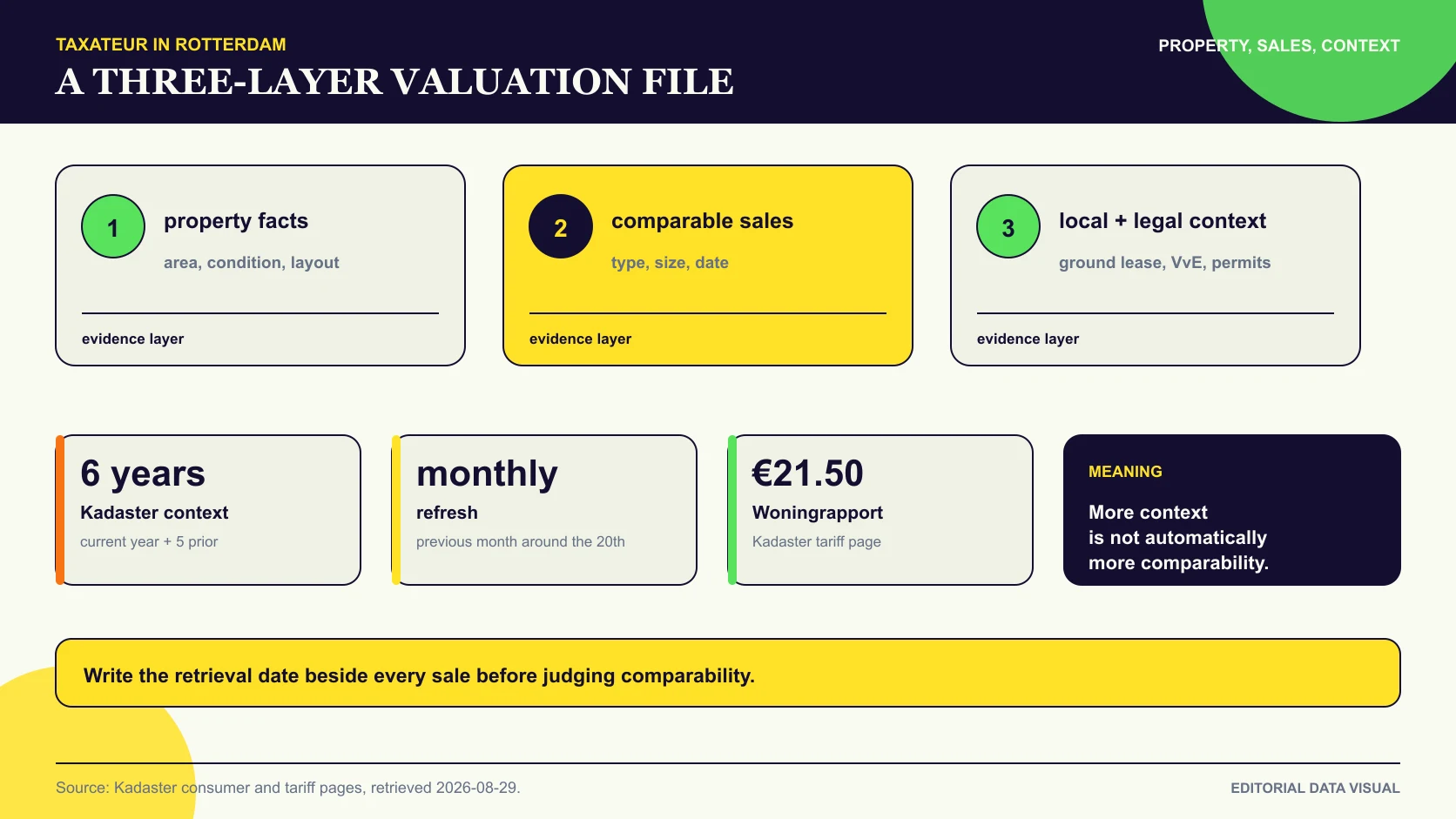
A useful valuation file has three layers. The first is the property: floor area, plot, rooms, access, condition, improvements, energy information and legal rights. The second is the market: comparable sales selected for time, location, type, size and condition. The third is context: ground lease, VvE papers, permits, environmental information and the purpose of the report.
Do not let one layer stand in for the others. A sale price proves that one transaction happened. It does not describe every detail of your home. A floor area can be accurate while a layout change lacks permission. A good report explains how the pieces were weighed.
Questions that need a closer answer
The right follow-up depends on the decision:
This hub view keeps one article from carrying every possible question. It also gives each document a clear place in the file.
Use the result for the right decision
Kadaster lists Koopsominformatie at €3.70. The product covers private sales in the same postcode area from the current year and the five preceding years. The price tells you what the public product costs. The five-year window tells you the period available for orientation. Neither fact turns the product into a valuation report.
A physical report for an NHG file has another date check. NHG states that such a report may be at most six months old from the valuation date. The lender’s own instructions still govern the file. This is a rule about report age, not a forecast of Rotterdam prices.
Prepare a valuation brief
Before contacting a valuer, put these items in one document:
- The purpose and recipient.
- The address, property type and ownership position.
- The requested value date and any deadline.
- Floor plans, lease or VvE documents, permits and energy information.
- Planned work, if the report must discuss an after-work value.
- The question you want the report to answer.
Here is a simple illustration. Suppose a fictional home measures 82 m² and an evidence set suggests a working value of €420,000. The calculation is €420,000 ÷ 82 = about €5,122 per m². That figure describes the fictional file only. It cannot serve as a Rotterdam benchmark because the example omits location, condition, date and comparable selection.
Mistakes and exceptions
A common mistake is to compare two figures without comparing their dates. A second is to treat the highest comparable sale as the natural answer. A third is to add renovation cost euro for euro to a current value. Cost, contribution to value and future demand can differ.
Apartment owners should read the VvE file. Rijksoverheid says a VvE must reserve for future major maintenance. Without a multi-year maintenance plan, the fallback is at least 0.5% of the building’s rebuild value. That percentage describes the reserve rule, not the market value of an apartment. The reserve balance, planned work and each unit’s share still need to be read.
Frequently asked questions
Can I value my home with online information?
Online estimates and public sales records can help you form a first question. A lender, buyer or legal process may require a report with a stated purpose, date and recipient.
Does a high WOZ value mean the home is worth that amount today?
The WOZ value follows a municipal reference date. A private valuation uses its own assignment date and evidence. Compare both dates before comparing the amounts.
Does a renovation always raise the value by its cost?
No fixed conversion applies. The finished quality, buyer demand, legal position, layout and local comparable evidence all matter.
What should I ask a valuer first?
Ask which purpose and recipient the proposed report covers, which value date will be used, what documents are needed and how comparable evidence will be explained.
Which question should you ask next?
For a home with party walls, keep the relevant building facts next to the comparable-sales notes.
A broad provider choice still depends on evidence rather than headline ratings.
Keep purpose, recipient, date and the open evidence question together before you ask for a report.
Send a clear question
Send the purpose, property type, valuation date and document line you want explained through the English contact form. Leave out identity documents and financial account details.Ask a valuation question