What does a property appraiser do? Role, evidence and limits
Find out what a Dutch property appraiser does, from the assignment and inspection to evidence, report writing and lender boundaries.

TL;DR
Are you arranging a valuation and wondering what the appraiser actually does? The appraiser gives a reasoned opinion for a stated purpose, recipient and valuation date. The work connects physical property facts, legal position and comparable evidence. Mortgage approval, permits and WOZ assessments belong to the lender, municipality or other authority responsible for that decision.
Before you rely on the result, ask whether the report makes those three anchors visible. A number without them is hard to use.
What a property appraiser is
If you are choosing a valuer in another market, compare the roles described by what a property valuer does in Amsterdam with the assignment you need in Rotterdam.
When you choose a valuer, compare the assignment with NRVT independence and objectivity so the role and evidence remain clear.
If you are deciding what the assignment should answer, connect the valuer’s work to a property valuation with a clear purpose and valuation date.
In Dutch housing work, a taxateur examines a property and prepares a valuation report for an agreed assignment. “Appraiser” and “valuer” are English labels for the role; the report still follows the Dutch purpose and recipient.
The value opinion belongs to one property at one moment. A report for a mortgage may have document and NWWI review conditions. A private orientation may answer a narrower question. The role stays evidence-led, while the file changes with the decision.
NRVT’s professional rules describe objectivity and independence. That conduct framework supports questions about the assignment; registration alone does not tell you whether a proposed report fits a lender’s instruction.
Attributes of the work
Look for four attributes in a clear assignment:
- Property facts: size, layout, condition, improvements, access and legal position are identified.
- Market evidence: comparable sales are selected and adjusted for relevant differences.
- Assignment context: purpose, recipient and valuation date are stated.
- Reasoning: the report explains how the evidence supports the value opinion and where assumptions remain.
The appraiser may inspect, measure, ask for documents and research public property information. The report should leave a trail from the property to the conclusion without turning an estimate into a promise.
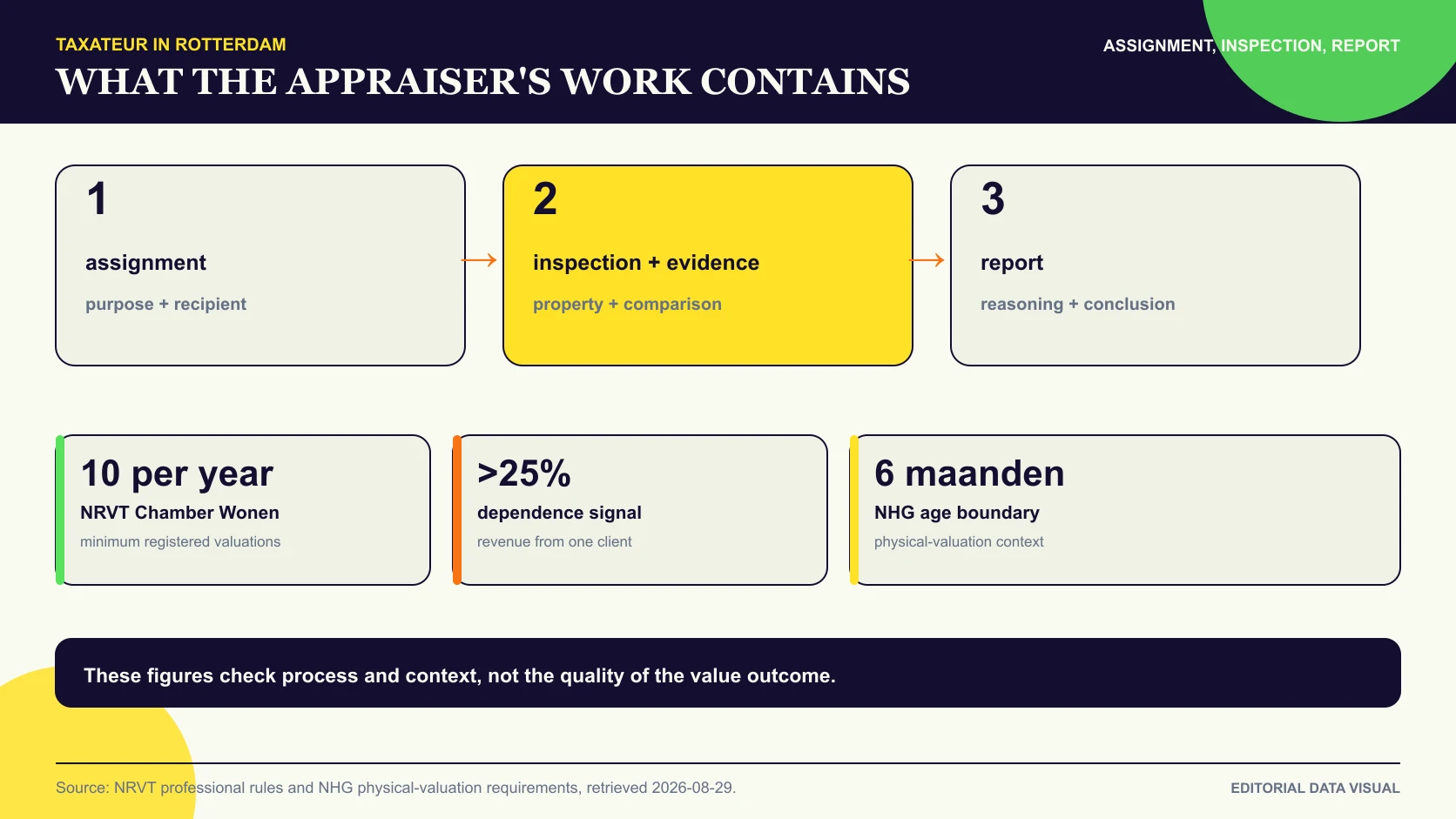
Three phases
Phase 1: brief. State the address, property type, owner or buyer position, purpose, recipient, date and deadline. Mention planned work, ground lease, VvE documents, permits or another fact that could change the question.
Phase 2: investigation. The appraiser reviews the property, documents and comparable evidence. Ask how missing information will be marked. A future extension should appear as an assumption rather than as an existing room.
Phase 3: report. Read the value date, property description, comparable sales, adjustments, assumptions and intended use. If the report is for NHG, NHG says a physical report must be made independently, validated by an accepted institute and be no more than six months old from the valuation date in that context.
Terms often confused
WOZ value. The municipality uses a WOZ value for taxation and other public tasks. Rijksoverheid says the value date is 1 January of the previous year and the notice is valid for one year. A private valuation answers a different assignment.
NWWI review. NWWI describes NWWI review as checking the appraiser and report against set quality requirements. The appraiser’s value opinion and the lender’s decision remain separate.
Online estimate. A model or public-sales product can support early orientation. It does not automatically become a report for a named recipient.
Three practical examples
Buying a home. The appraiser may be asked whether market evidence supports a purchase and whether the report can enter a mortgage file. Keep the agreed price, lender instruction and valuation date together.
Renovating a home. The brief may need a present value, a planned post-work value or both. Drawings, cost evidence, permission and completion assumptions belong beside the assignment.
Checking a private question. A homeowner may ask for an orientation before sale. A public record can frame that question. A professional report is needed when another party requires a documented opinion.
Use this simple illustration: a fictional 82 m² home valued at €420,000 gives €420,000 ÷ 82 = about €5,122 per m². It is a fictional calculation, not a Rotterdam benchmark. Area, location, condition, date and comparable selection all change the meaning.
What the role does not decide
The appraiser does not decide how much you can borrow. Rijksoverheid says a mortgage can generally cover up to 100% of the home’s value, while income and debt rules also apply. The lender checks the whole application.
The appraiser does not grant a permit or certify construction work. Use the Omgevingsloket for the government process and a qualified building professional for technical questions. The report can describe an assumption; it cannot turn an unresolved permit into a fact.
The appraiser does not promise a sale price. A value opinion depends on its date, evidence and assignment. New market information can change a later decision.
Frequently asked questions
Does an appraiser set the asking price?
The assignment can support a pricing conversation, but an asking price and a valuation opinion serve different decisions. Keep the purpose visible.
Must every appraiser be NWWI validated?
The answer depends on the recipient and product. Ask the lender which report and NWWI review path it accepts.
Is a register proof that the report is suitable?
Registration supports a professional-status check. Read the proposed assignment, recipient, date and evidence requirements as well.
How long does a valuation stay useful?
Use the rule set by the recipient. In an NHG physical-report context, NHG describes a six-month maximum from the valuation date.
Ask about an appraisal role
Use the English contact form for a general question about the assignment, report wording or role division. Include the purpose, recipient and valuation date, without identity documents or financial details.Ask about the appraisal role