10 mistakes in a property valuation and how to avoid them
Avoid ten property-valuation mistakes by checking the purpose, dates, property facts, evidence, recipient and limits before relying on the report.

Are you about to rely on a property valuation? Check the question before you check the number. An unclear purpose, missing date, incomplete property facts or unnamed recipient can weaken the file before the conclusion is written.
If a lender is involved, put the report date and recipient beside the checks in a Dutch mortgage valuation report.
If the purpose remains open, write down the missing purpose, recipient and date with ten questions about residential property valuations.
If your lender asks for an NHG file, compare the NHG physical valuation report requirements with the recipient’s brief before you set the valuation date.
The ten mistakes pair each risk with a prevention step and a practical example. Use them to prepare a clearer brief and spot what still needs an answer.
TL;DR
State the purpose, two relevant dates, the property facts, the evidence and the report recipient. Ask how the conclusion is supported and which limits remain. A lower number can still be well supported; a convenient number can still be poorly supported.
The 2026 Q1 CBS index of 153.6 on a 2020=100 basis, up 5.2% year on year, is a reminder that market evidence needs a period. The index gives national context; property-specific analysis still governs any change to a Rotterdam conclusion.
Ten mistakes and how to prevent them
The ten items were built from official standards and common file decisions. NRVT provides the objectivity and own-investigation lens. Rijksoverheid and the Waarderingskamer clarify dates and WOZ context. NHG illustrates recipient and report-age conditions. The prevention rule is simple: name the question before collecting or comparing the evidence.
Keep your actual home and valuation date as the decision basis, and compare local sales signals with property valuation in Woensel.
The ten mistakes fall into five themes. The counts describe the comparison structure and say nothing about how often errors occur.
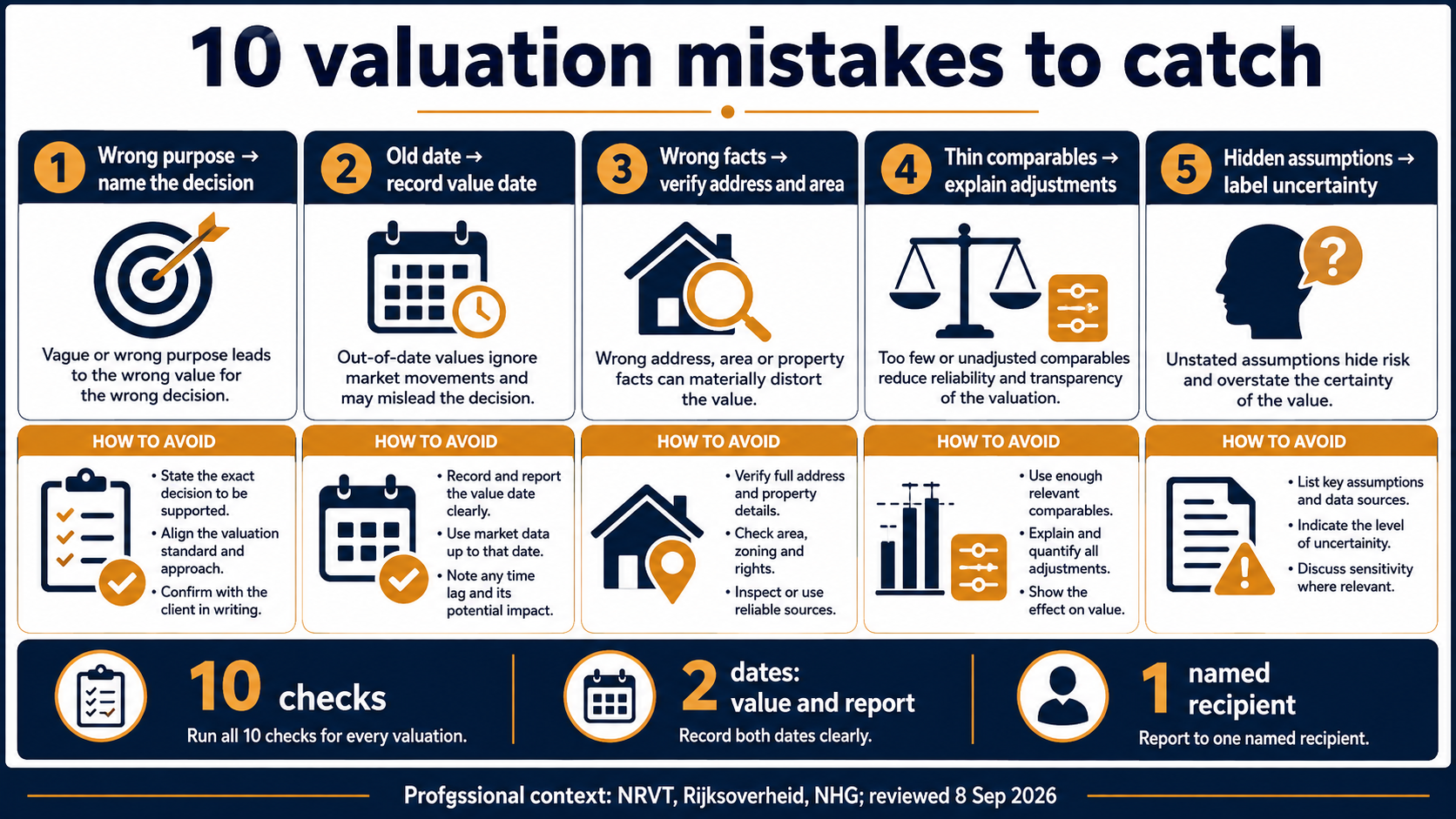
Top 10 mistakes and the prevention action
1. Starting with a desired number
A requested outcome can distort the question and the evidence review. State the purpose and let the valuer investigate independently. NRVT describes objectivity and independence as foundations of the work.
2. Leaving the recipient unnamed
A report for a mortgage lender can have different conditions from an owner’s orientation question. Put the recipient or intended use in the brief before the appointment. A named recipient determines which report type and age rules matter.
3. Mixing WOZ and market value
The WOZ value follows a municipal tax purpose and an earlier value date. A current market question has a different evidence frame. Keep the labels separate in the file and in any comparison of numbers.
4. Omitting the valuation date
Market evidence changes with time. Include the value date, property state date where relevant and the decision deadline. The Waarderingskamer distinguishes value date from state date, and that distinction can change how an old comparable should be interpreted.
5. Treating nearby sales as automatically comparable
Distance is only one feature. Size, condition, rights, quality, location, date and property type can alter the comparison. Ask what made each reference suitable and how differences were considered.
6. Supplying an incomplete property file
Missing floor area, alterations, leasehold or association information can hide a material difference. Provide the available records and state what is missing. An incomplete file should lead to a stated limit rather than silent certainty.
7. Treating an online indication as a formal report
An online estimate can orient a homeowner. A lender-facing assignment needs a defined purpose, evidence, recipient and report format. Give the estimate its correct role before relying on it in a contract or mortgage decision.
8. Reusing an earlier report without fresh investigation
NRVT disciplinary material states that copying an earlier report is not an independent valuation. A new date, purpose or property condition calls for a new investigation. Earlier material can be background when its origin and limits are clear.
9. Blending current value with value after improvement
Plans, assumptions and completed work belong to different evidence states. NHG 2026 distinguishes current value from value after improvements in the relevant context. Label the state of the property and the assumptions behind any future scenario.
10. Ignoring the report’s limits after reading the headline
The conclusion needs its purpose, date, evidence and qualifications around it. A report can support a property-value question while leaving income, tax, legal and contract decisions open. Keep the limitations beside the number when sharing the file.
Comparison cards: where does your file need work?
Scope gap. Purpose, recipient or report type is unclear. Write the decision in one sentence and name the party who will rely on the result.
Date gap. Value date, property state or deadline is missing. Put the dates in the brief and ask which one governs the recipient’s acceptance.
Evidence gap. Property facts or comparable reasoning are incomplete. Gather records, mark unknowns and ask how differences are weighed.
Independence gap. The request contains a target number or relies on a copied conclusion. Reframe the question around investigation and evidence.
Limit gap. The headline is being used for a wider mortgage, tax or contract decision. Keep the professional who owns that decision in the conversation.
How to choose the next check
Record the valuation date and acceptance date. Add the recipient, property changes and three evidence questions. If a lender is involved, compare the report date and recipient with the lender’s requirements. If the property question is still broad, write the missing purpose, recipient and date alongside the other file facts.
Common questions
Is a low valuation automatically a mistake?
No. A conclusion can be lower than an offer and still be supported by the evidence. The question is whether purpose, data, reasoning and limits are clear.
Is the closest comparable the best one?
Not necessarily. Similarity in type, condition, rights, date and location can matter more than distance alone.
Does a new report always fix an incomplete file?
No. The missing records still need to be found or recorded as uncertainty. A new inspection cannot silently replace unknown property facts.
Can a lender accept any valuation report?
The recipient sets the conditions. In an NHG physical-report context, independence, accepted NWWI review and report age matter; another lender can state different terms.
Use the questions before relying on a conclusion
Report contents, mortgage conditions, valuation dates and comparable evidence can each expose a different weakness. Turn each prevention action into a question before relying on the conclusion.
What these checks can tell you
No error rate, provider ranking or property-value claim is presented. The only market figure is dated national CBS context, while the numbers count the comparison checks. A qualified valuer and named recipient remain responsible for the assignment-specific conclusion.
Ten valuation mistakes become prevention questions about purpose, dates, evidence and the recipient. If you want to ask about a report line or missing record, send a focused general question through the English contact form. Please leave passports, contracts, bank details and other personal documents out of the public form.Ask about a valuation file