Valuing a home before renovation: a practical evidence guide
Plan a before-and-after home valuation with separate figures for the current property, planned work, post-work value, permits and lender requirements.
TL;DR
Are you planning a renovation and need a valuation? Ask how the file will separate the current value, the expected value after the work and the cost of the work. Keep permits, plans and assumptions visible. Money spent on building work does not automatically add the same amount to market value.
Under the 2026 NHG hybrid conditions, the total loan may not exceed 90% of the market value before the improvement in the described quality-improvement cases. A physical report may be needed when the lender wants the value after the work or when the case falls outside the hybrid conditions. Confirm the product and file rule before ordering.
Before you price a renovation-related assignment, compare the preparation steps with preparing a home for property valuation in Amsterdam and keep proposed work separate from observed condition.
If a lender is involved, compare the recipient, valuation date and evidence with Dutch mortgage valuation report requirements before you order the report.
Before you ask for a renovation valuation
Describe the property as it stands today. Include floor area, rooms, access, condition, building parts, energy label, lease position and VvE information. Then describe the intended result with a plan, drawings, surfaces, installations, finish level and expected completion.
A short brief should answer:
- Which work is planned?
- Which work is already completed?
- Which permits or notices may apply?
- Who will receive the report?
- Is the lender asking for a value before work, after work or both?
- Which date controls the decision?
Rijksoverheid’s Omgevingsloket permit rules show whether a project needs a permit or notification and which local rules apply. Run that check before describing an unapproved plan as part of the finished home.
Prepare the before-and-after file
Use three steps.
Step 1: record the present state. Save dated photographs, floor plans, measurements, existing defects, energy documents and the current legal position. The present value needs a clear starting point.
Step 2: separate work from value. Keep contractor quotes, material estimates, invoices and your own labour notes in a cost sheet. The cost sheet answers what the work may cost. The valuation file answers what the finished home may be worth.
Step 3: mark assumptions. Write down which planning permission, VvE decision, contractor appointment and completion date remain open. An assumption that changes later should trigger a refreshed question.
The energy label gives one useful date check. Rijksoverheid says a home energy label is valid for 10 years and must be available to a buyer or tenant in the situations described by its energy-label rules. The label informs the file; it does not set the value by itself.
A worked example with three values
Use this fictional calculation to understand the structure:
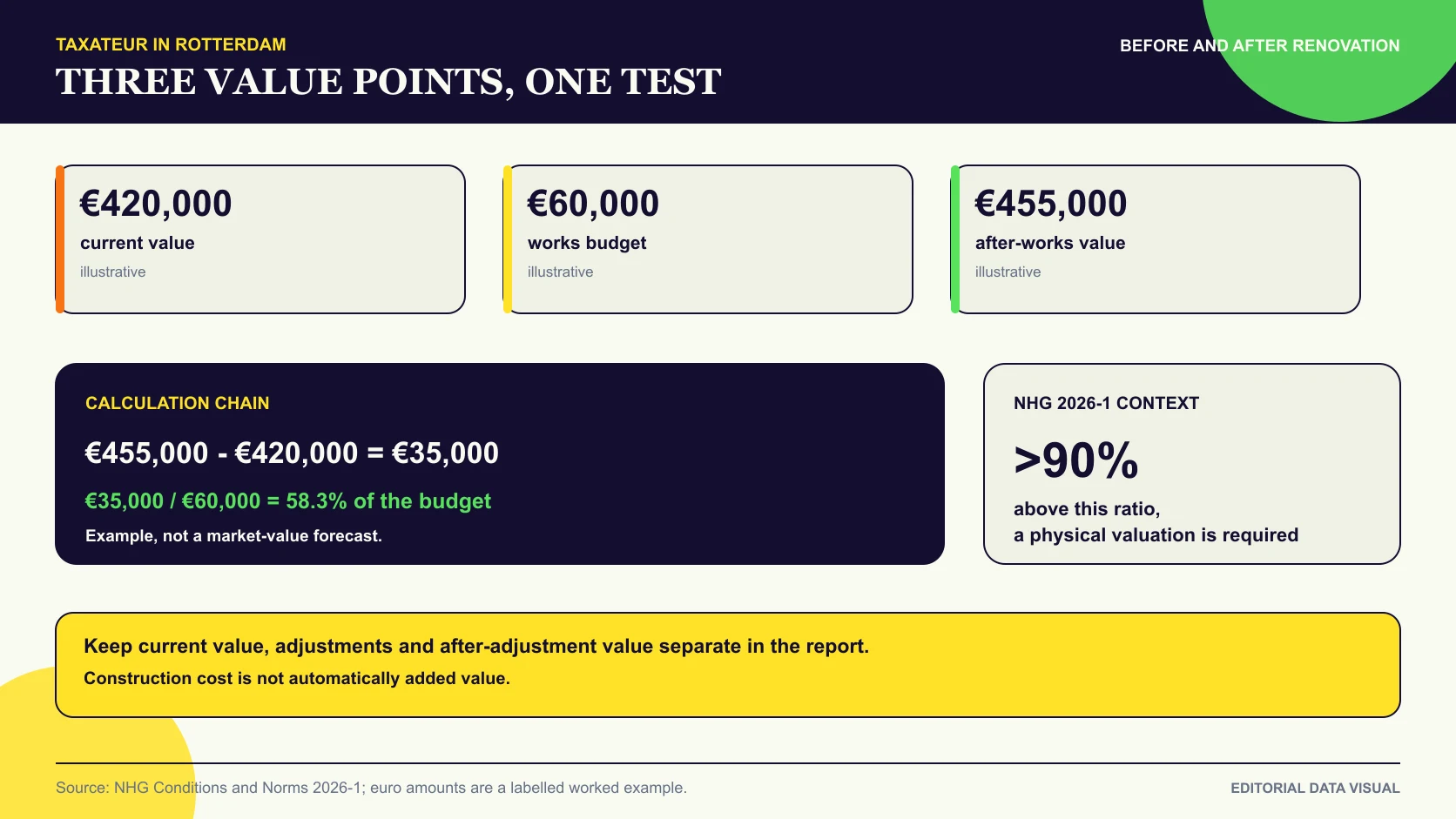
- present value: €420,000;
- planned works: €60,000;
- planned value after completion: €455,000.
The apparent increase is €455,000 − €420,000 = €35,000. That covers 58.3% of the fictional work budget because €35,000 ÷ €60,000 × 100 = 58.3%. These are fictional figures, not Rotterdam market observations. Keep cost and value in separate columns, then ask which work supports the €35,000 difference and which work serves comfort rather than price.
Plan work, permission and lender evidence
A lender may require the report to describe the market value at the valuation moment, the changes needed and the market value after the changes. NHG’s 2026-1 conditions use this three-part structure for a home where the post-improvement value matters.
For a VvE apartment, add the meeting decision, budget, reserve position and permission for work affecting common parts. Rijksoverheid says a VvE must reserve for major maintenance. Without a multi-year maintenance plan, the minimum fallback is 0.5% of the building’s rebuild value each year. That rule helps you read the VvE file. It does not tell you what the private renovation adds to market value.
When renovation is tied to a loan application, keep the recipient, date and report evidence together.
Compare the finished home with local evidence
A valuer can test the planned result against comparable finished homes. Ask which features support the comparison: living area, layout, outdoor space, energy performance, parking, tenure, condition and location. A larger kitchen may matter when buyers in the same part of Rotterdam pay for that layout. A premium finish can matter less when the surrounding evidence does not show a matching price level.
The central challenge is easy to miss: a larger budget can produce a better home without producing the same increase in market value. Comfort, durability and resale value are different outcomes. Keep all three visible when judging the plan.
Where renovation plans lose their meaning
The file becomes weak when the plan has no drawing, the cost sheet mixes estimates with invoices, the completion date is vague or a legal condition is ignored. A second failure comes from comparing the finished plan with unadjusted sales. A third comes from presenting a future value as if the work is already complete.
Those NHG conditions exclude planned improvements from the value determined by a hybrid valuation in the described cases. The pre-improvement value leads there, and the total loan may not exceed 90% of it. Ask the lender which valuation type fits your file before you calculate the renovation outcome.
Review after the plan changes
Refresh the file when the floor plan, budget, permit position, materials, lender or completion date changes. Recheck the energy-label date, VvE permission and report recipient. Keep the original assumption beside the new one so the change can be explained.
Frequently asked questions
Does every renovation need a new valuation?
The answer depends on the lender, purpose, stage of work and requested value. Ask the lender which report type it accepts and whether it needs a present value, a post-work value or both.
Can a hybrid valuation include the value after renovation?
NHG’s hybrid-valuation guidance says the improvements are not included in the value for the described quality-improvement cases. A physical valuation may be needed for a post-improvement value.
Is an energy label enough proof of a higher value?
An energy label records energy performance for its validity period. A valuation also considers property condition, layout, market evidence and the assignment purpose.
What if the work needs a permit?
Check the plan in the Omgevingsloket and ask the municipality or another qualified adviser about the application. A valuation file should state the permit assumption clearly.
Send the renovation brief
Use the English contact form for a general question about your brief, value date or report wording. Leave out identity documents, bank details and sensitive attachments.Ask about a renovation valuation